
the phubbing phenomenon
Phubbing has become normal in many families because smartphones are easy to access and widely used (Chotpitayasunondh & Douglas, 2016). It happens in different situations, like during meals, conversations, or even bonding time. In the case of parental phubbing, parents pay more attention to their phones than their children (McDaniel, 2020). Over time, this behavior can become a habit and even be passed down, making phone focused interaction feel normal in the household.
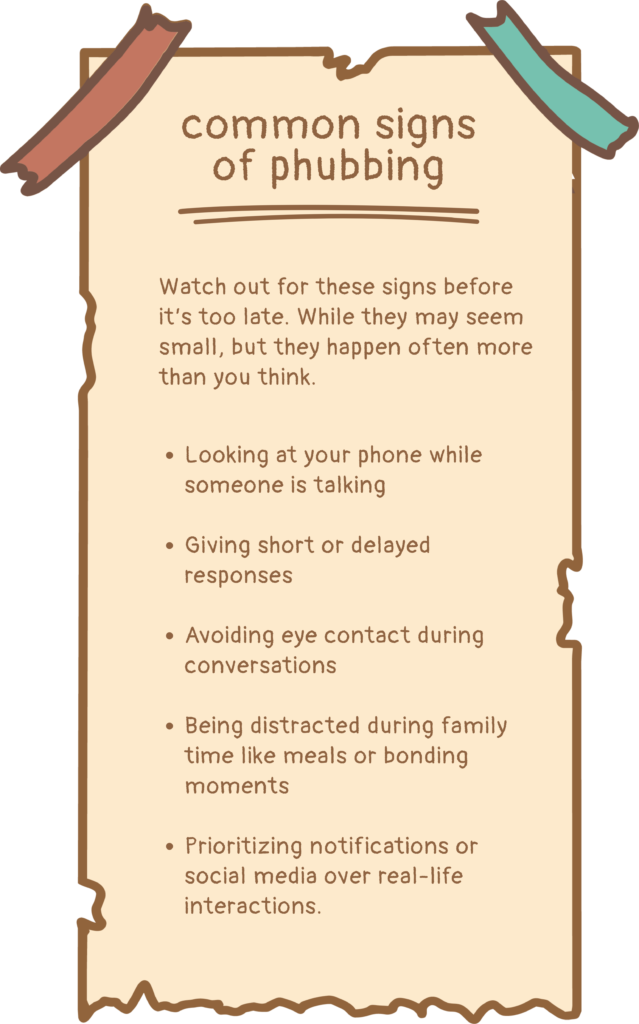
In families, this behavior can be noticed when parents or children focus more on their screens instead of talking to one another. Even if it is not done on purpose, it can definitely make others feel ignored or unimportant (Wang et al., 2020). As time passes by, these small moments can add up and affect how family members connect and communicate with each other.
Over time, this behavior can turn into a habit. When phone use becomes more important than real conversations, family members may start to talk less and spend less time together. Children may also get used to this behavior and think that it is normal, which can lead them to the same in their relationships and social interactions in the future. Because of this, Phubbing can slowly affect how families communicate and understand each other. According to Elias and Lemish (2021), frequent phone use during shared moments like eating together and special family moments reduces the quality of family interaction.
the impacts
Phubbing can make children feel ignored or less important, especially when it happens during conversations or family bonding (Niu et al., 2020). Even if parents do not mean it, focusing on their phones instead of their children can create feelings of sadness, frustration, or being unvalued. Over time, this can affect how children see their relationship with their parents.
It also affects communication inside the family. Conversations may become shorter, less meaningful, or even interrupted. When this happens a lot, family members may stop trying to open up or share their thoughts. These issues can lead to misunderstandings, lack of connection, and even tension between parents and children. According to Bhau and Nasrulla (2025), parental phubbing is linked to lower relationship quality and weaker emotional bonds between parents and children.
In the long run, phubbing can definitely weaken the emotional connections and affect mental well being (Harianti & Kurniawan, 2022). Children may feel distant from their parents or look for attention elsewhere, like online. Even if phubbing feels normal in many homes, its effects can slowly build up and change the overall relationship and closeness within the family. Research by Jin et al. (2023) and Li et al. (2025) also shows that it may contribute to problems like depression, social anxiety, and unhealthy phone use among adolescents.
Research by Jin et al. (2023) and Li et al. (2025) also shows that it may contribute to problems like depression, social anxiety, and unhealthy phone use among adolescents.
how to mitigate phubbing habits
Do you want to prevent these problems? Are you afraid that these could affect you and maybe even your family?
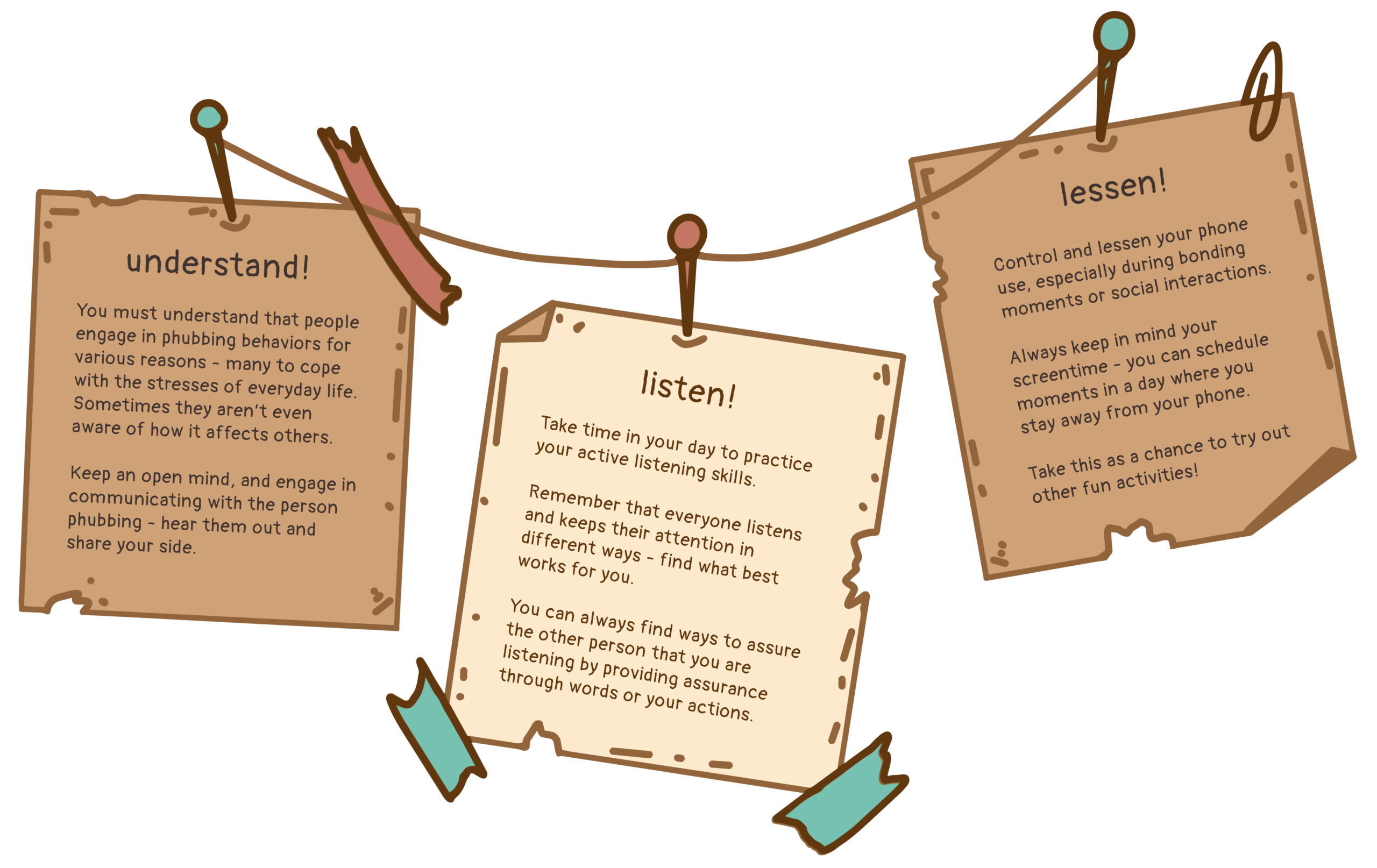
Here are some suggestions on ways you can that can reduce your phubbing habits.
an expert's feedback
To better understand parental phubbing, the researchers consulted Mr. Vincent Feliciano, a Guidance Counselor and Instructor from Central Luzon State University. With his experience, he provided helpful insights that supported the findings of the study.
According to Mr. Feliciano, parental phone use can affect how families communicate and connect with each other. When parents focus more on their devices, it can change the way children feel and respond within the family. This may lead to weaker communication and emotional distance over time.
He also explained that this behavior is influenced by how people use technology in their daily lives. Based on ideas like Media Ecology Theory and Uses and Gratification Theory, parents may turn to their phones for comfort, information, or entertainment, which can sometimes take their attention away from their children.